
Offshore Oil & Gas 101: How It Works | NOIA
Offshore Oil & Gas 101: How Exploration, Drilling, and Production Work
The world's oceans hold some of the largest untapped reserves of oil and natural gas left on Earth. Reaching them takes decades of engineering innovation and a rigorous, layered commitment to safety. Offshore oil and natural gas don't just power vehicles and heat homes — they're also refined into the raw materials behind everyday products, from clothing and eyeglasses to smartphones, laptops, and medical devices like MRI machines and pacemakers.
As of 2025, the Gulf of America produces an estimated 1.8 million barrels of crude oil per day — roughly 13% of total U.S. crude oil production — according to the U.S. Energy Information Administration.
Getting oil and natural gas from beneath the seafloor to consumers — and eventually returning that seafloor to its natural state — happens across four distinct phases.
The 4 Phases of Offshore Operations
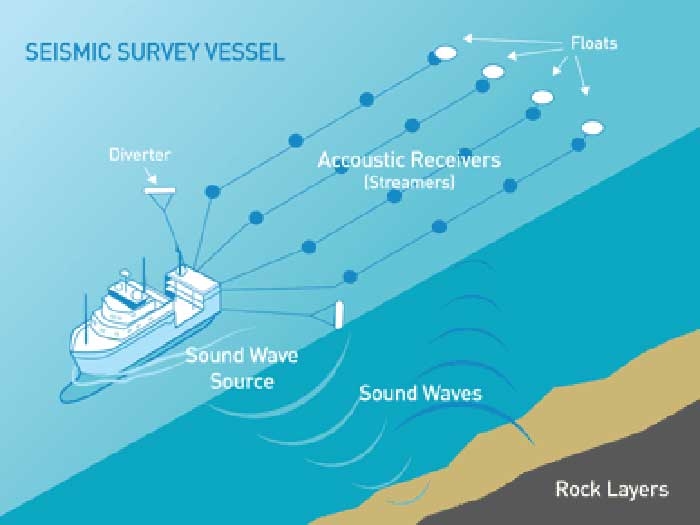
- Exploration — Energy companies lease ocean tracts from the federal government and conduct seismic surveys, towing arrays of compressed-air chambers that bounce sound waves off the seafloor to map underground rock formations.
- Drilling — Once a viable reserve is located, drillships, jackup rigs, or semisubmersibles drill into the seabed. As the well gets deeper, steel casing is cemented into place to protect both well integrity and the surrounding marine environment.
- Production — After reaching the oil or gas deposit, companies install fixed or floating production platforms. Resources are extracted, processed to remove water and impurities, then transported to shore via subsea pipeline or specialized tanker.
- Decommissioning — When a well is no longer commercially viable, operators plug it securely and dismantle or reef the platform structure in accordance with federal environmental regulations enforced by the Bureau of Safety and Environmental Enforcement (BSEE).
Quick Reference: Common Offshore Platform Types
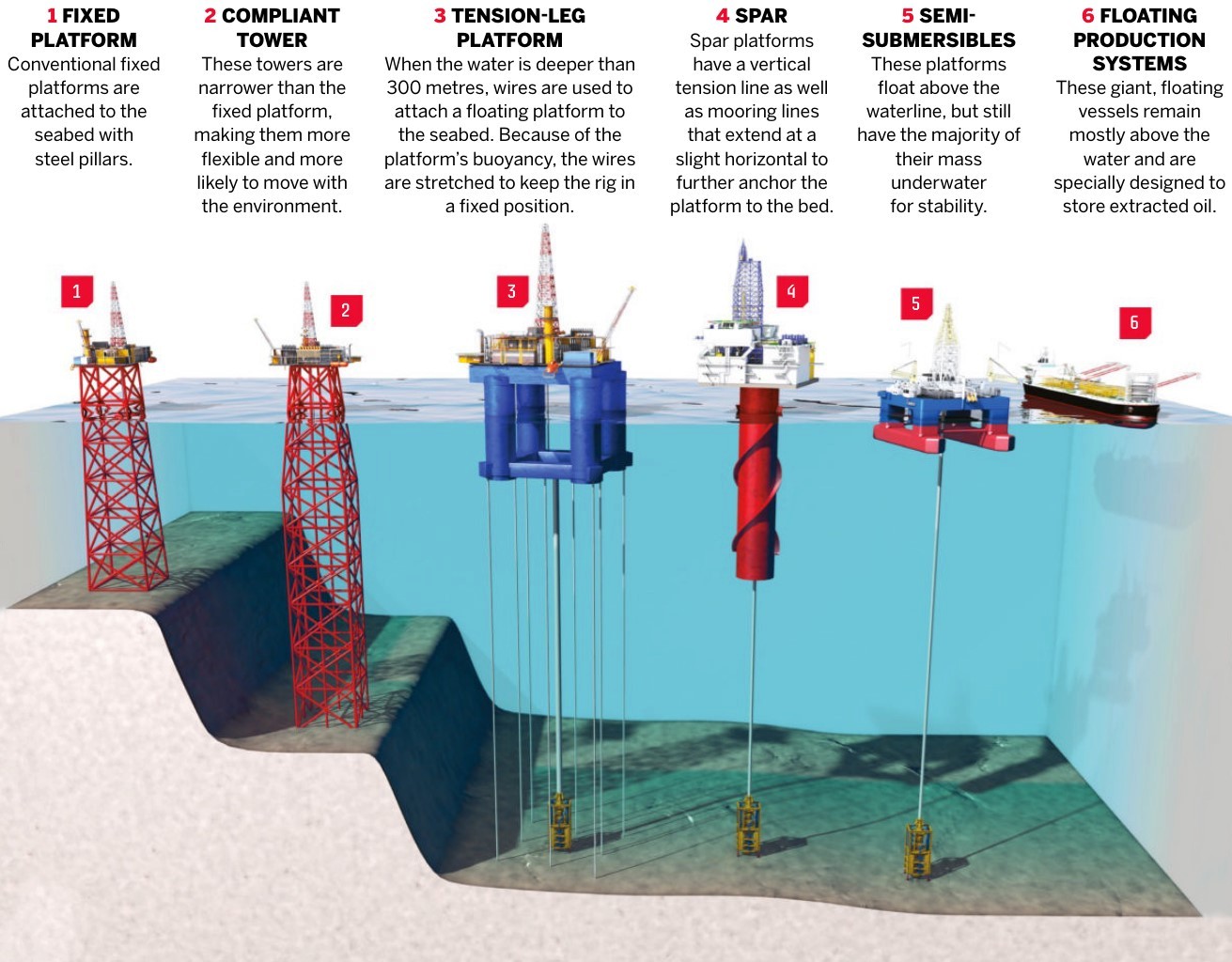
- Fixed Platforms — Steel legs driven directly into the seabed. Best suited to shallow water, generally under 1,500 feet.
- Floating Production, Storage & Offloading (FPSO) vessels — Ship-shaped vessels moored in deep water that process and store oil before transferring it to shuttle tankers.
- Tension Leg Platforms (TLPs) — Floating structures tethered to the seafloor by rigid tendons, limiting vertical movement.
- Spar Platforms — Deep-draft, floating cylindrical structures offering high stability in ultra-deepwater.
- Semisubmersible Platforms — Float on large submerged pontoons, held in place by anchors or dynamic positioning. Used both as mobile drilling rigs and, once outfitted with production equipment, as permanent production platforms — where they're typically referred to as Floating Production Systems (FPS).
Exploration: Finding What's Beneath the Seafloor
Before any oil or natural gas can be extracted, it has to be found. Geophysical companies conduct scientific surveys of offshore areas using sound waves bounced off the seafloor. A seismic survey vessel tows an array of air chambers filled with compressed air, which release bursts of high-pressure energy into the water. Hydrophones — spaced along cables trailing behind the vessel — detect and record the returning sound waves, mapping what lies beneath.
Strict mitigation measures are used throughout this process to protect marine mammals and other marine life.
Geophysical surveys aren't just for oil and gas — the same technology is used to site offshore wind farms and locate sand and gravel deposits for coastal restoration projects.
Visit the EnerGeo Alliance to learn more about seismic exploration!
Drilling: Mobile Offshore Drilling Units (MODUs)
Once a prospective reserve is identified, companies drill highly regulated exploration wells using Mobile Offshore Drilling Units (MODUs). There are four main types:
- Submersible/Barge MODU— rests on the seafloor in shallow water, typically 30–35 feet deep, with a drilling platform on steel posts above the waterline. Best suited to calm water.
- Jackup Rig — towed to the drill site on a barge, then extends legs to the seafloor and ratchets the platform above the waterline for stability against tides and waves. Operates in depths up to roughly 525 feet.
- Drillship — a ship with a drilling rig mounted on deck, drilling through a hole in the hull. Uses anchors and propellers to hold position in deep water.
- Semisubmersible — floats on huge submerged pontoons, using anchors (and sometimes onboard propulsion) to stay positioned. Some can convert directly into production rigs once oil is found, eliminating the need for a second vessel.
Once drilling begins, a riser — the part of the drill extending from the rig down through the water — allows drilling fluids to circulate. Engineers lower a drill string (a series of connected pipes) through the riser to reach the target depth.
At the seafloor sits the blowout preventer (BOP): hydraulically powered clamps that can instantly seal the well pipe in the event of a pressure surge. It's one of many overlapping safety systems built into every offshore well.
To stabilize the well, engineers install cement-lined metal casings that narrow as depth increases — the same basic principle used in land-based drilling, adapted for offshore pressures. When oil is struck, engineers seal the well with two plugs (held in place by drilling mud or seawater pressure) to prepare it for a production rig.
Production: Engineering Platforms for Every Ocean Environment
Once a well is confirmed commercially viable — and all required regulatory approvals are in place — operations shift from drilling to production. The industry has engineered a distinct platform type for nearly every depth and environmental condition:
| Platform Type | How It Works | Typical Depth Range |
|---|---|---|
| Fixed Platform (FP) | Steel jacket driven into the seabed, deck on top for crew, drilling, and production | Up to ~1,500 ft |
| Compliant Tower (CT) | Narrow, flexible tower designed to flex under lateral forces rather than resist them | ~1,000–2,000 ft |
| Tension Leg Platform (TLP) | Floating structure held by tensioned vertical tendons anchored to the seafloor | Up to ~4,000 ft |
| Mini-TLP | Lower-cost floating TLP for smaller or early-stage deepwater fields | Varies |
| Spar Platform | Large-diameter floating cylinder anchored by a taut mooring system | Up to ~3,000 ft (technology allows up to ~7,500 ft) |
| Floating Production System (FPS) | Semi-submersible unit with drilling and production equipment, moored or dynamically positioned | Ultra-deepwater |
| Subsea System (SS) | Wells on the seafloor tied back to a nearby platform or distant facility via pipeline | 5,000+ ft |
| Floating Production, Storage & Offloading (FPSO) | Tanker-style vessel that processes and stores oil, then offloads to shuttle tankers | Remote deepwater fields without pipeline access |
Offshore Pipelines: Moving Oil and Gas to Shore
Offshore pipelines connect wells to platforms and platforms to shore, and fall into three categories:
- Infield pipelines (flowlines) — carry a mixture of oil, gas, and water from subsea wells to a manifold or processing platform; some also carry processed water back to injection wells for disposal.
- Export pipelines — carry processed oil or gas from the platform to shore. A pipeline carrying both oil and gas is multi-phase; one carrying only oil or only gas is single-phase.
- Transmission pipelines — move oil or gas over longer distances, coast to coast, functioning much like a tanker route but underwater.
The Broader Offshore Ecosystem
Geophysical surveyors, drillers, and producers are just the most visible parts of the offshore oil and gas industry. Thousands of additional companies keep the industry running, including:
- Heavy-lift vessel operators and marine/helicopter transportation providers
- Steel fabricators and shipbuilders
- ROV (remotely operated vehicle) manufacturers
- Engineering and equipment firm
- Pipeline and offshore construction companies
- Legal, financial, and other professional services
How Is Offshore Drilling Regulated?
Offshore oil and gas development is one of the most heavily regulated industrial activities in the United States, overseen by multiple federal agencies at every stage — from leasing through decommissioning.
Where State Waters End and Federal Waters Begin
U.S. jurisdiction extends 200 nautical miles into the ocean, an area known as the Exclusive Economic Zone (EEZ). Within that zone, jurisdiction is split:
- State waters generally extend 3 nautical miles from shore. Texas and the Gulf coast of Florida are the exceptions, with state jurisdiction extending 3 marine leagues (about 9 nautical miles) under historical boundaries recognized in the Submerged Lands Act of 1953.
- The Outer Continental Shelf (OCS) begins where state waters end and falls under federal jurisdiction.
The Five-Year Leasing Program
Under the Outer Continental Shelf Lands Act (OCSLA) of 1953, the U.S. Department of the Interior — through the Bureau of Ocean Energy Management (BOEM) — manages OCS oil and gas leasing through a recurring National OCS Oil and Gas Leasing Program, commonly called the "five-year program." Before any lease sale can be held, BOEM must publish a proposed program along with an environmental impact statement, and hold a public comment period open to industry, coastal-state governors, and the general public.
The number of lease sales scheduled has varied significantly by administration. The 2024–2029 program scheduled just three lease sales — the fewest of any five-year program to date. In November 2025, BOEM released a draft proposed program for 2026–2031 that would schedule up to 34 potential lease sales across 21 of 27 OCS planning areas, covering roughly 1.27 billion acres, as part of the Interior Department's stated goal of restoring a more predictable, robust leasing schedule. Separately, the 2025 budget reconciliation law (the One Big Beautiful Bill Act) now requires a minimum of 30 Gulf of America lease sales on a fixed schedule through 2040, independent of the five-year program — giving operators a level of long-term planning certainty that has often been missing from the leasing process.
Safety and Environmental Oversight
Once a lease is issued, offshore operations are governed by additional layers of federal law, including:
- The National Environmental Policy Act (NEPA), requiring detailed environmental review before major federal actions, including individual lease sales and project approvals.
- The Clean Air Act and Clean Water Act, regulating emissions and discharges from offshore facilities.
- The Coastal Zone Management Act, requiring coordination with affected coastal states.
- The Marine Mammal Protection Act (MMPA) and Endangered Species Act (ESA), which govern how offshore activity — from seismic surveys to platform operations — is planned and mitigated to protect marine mammals and listed species. In practice, this means operators secure Incidental Take Regulations (ITRs) authorizing limited, unintentional impacts on marine mammals during specific activities, and federal agencies complete Biological Opinions (BiOps) through ESA Section 7 consultation to confirm a project won't jeopardize a listed species before it can proceed.
- Safety and engineering standards enforced by BSEE, covering everything from blowout preventer requirements to well design, worker safety, and decommissioning.
This regulatory framework has evolved substantially over seven decades into one of the most rigorous offshore energy oversight systems in the world. Today's operators plan, drill, and produce under exacting engineering, safety, and environmental standards — reflecting decades of continuous improvement that have made U.S. offshore energy development a global benchmark for responsible resource development.