
Offshore Wind 101: How It Works | NOIA
Offshore wind is a homegrown American energy resource, generated by turbines anchored off the U.S. coastline and delivered directly to the population centers that need it most. Because major load centers like the Northeast and California sit close to strong, consistent offshore wind resources, offshore wind can add a reliable, domestically produced source of power to the grid while supporting American jobs, domestic manufacturing, and the U.S. maritime supply chain — from shipyards and ports to vessel operators and steel fabricators.
Offshore wind is one part of NOIA's broader vision for American offshore energy, alongside oil, gas, critical minerals, and carbon capture and storage. NOIA supports a durable, "all of the above" offshore energy strategy that keeps every domestic resource — including offshore wind — in play.
The State of U.S. Offshore Wind Today
The U.S. offshore wind industry has moved through several distinct phases since the first commercial lease sales were held over a decade ago. As of 2026:
- The Bureau of Ocean Energy Management (BOEM) administers dozens of active offshore wind leases along the Atlantic, Pacific, and Gulf coasts.
- A handful of projects — including Revolution Wind and Coastal Virginia Offshore Wind — are partially or fully constructed and delivering power to the grid.
- In January 2025, a presidential memorandum directed federal agencies to pause new offshore wind leasing and to temporarily halt new or renewed permits, rights-of-way, and approvals for offshore and onshore wind projects, pending a comprehensive review of federal wind leasing and permitting practices.
- BOEM subsequently rescinded its previously designated Wind Energy Areas, and several in-development leases have since been terminated through settlement agreements between developers and the Department of the Interior.
- Some previously permitted projects have been the subject of federal stop-work orders; several of those orders have been challenged in court, with judges issuing preliminary injunctions in some cases.
This is a dynamic and unsettled period for the industry. NOIA has publicly urged the administration to resolve outstanding reviews and permitting pauses so that permitted, already-vetted projects can move forward, arguing that offshore wind — like offshore oil and gas — is a legitimate part of a secure, diversified American energy portfolio and an anchor for U.S. maritime jobs and supply chains. Policies affecting offshore wind leasing and permitting continue to evolve, so developers, investors, and coastal communities should track BOEM's website and NOIA's policy updates for the latest status.
Overview of BOEM's Regulatory Framework
BOEM's authority to lease the Outer Continental Shelf (OCS) for renewable energy comes from the Energy Policy Act of 2005 (EPAct), which authorized the Department of the Interior to issue leases, easements, and rights-of-way for renewable energy development offshore. EPAct set the basic ground rules BOEM still operates within, requiring the agency to:
- Coordinate with relevant federal agencies and affected state and local governments
- Obtain a fair return to taxpayers for leases and grants issued on the OCS
- Ensure offshore renewable energy development proceeds in a safe, environmentally responsible manner
In 2009, the Department of the Interior finalized regulations establishing BOEM's OCS Renewable Energy Program, giving the agency a detailed structure for managing renewable energy leasing, meeting its statutory obligations, and balancing certainty for industry with flexibility to adapt as the sector matures. Those regulations have been updated periodically — most notably in 2011 — to reflect agency reorganization and lessons learned from early projects, and further changes are possible as federal wind policy continues to be reviewed.
BOEM also prepared a Programmatic Environmental Impact Statement (PEIS) evaluating the potential environmental effects of its renewable energy program across the OCS and identifying best management practices for the industry to follow. That PEIS, and its accompanying Record of Decision, remain a foundational environmental review underlying the federal offshore wind program.
The Four Phases of Offshore Wind Development
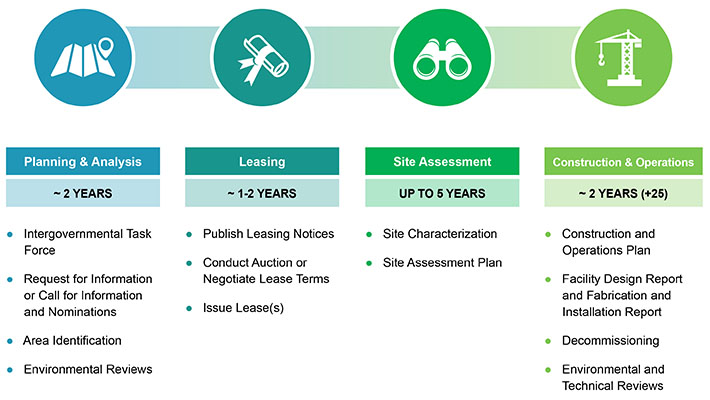
BOEM's renewable energy process is generally organized into four phases, with stakeholder engagement built in throughout to help manage conflicts among ocean users:
- Planning – BOEM identifies areas of the OCS with offshore wind potential and works with states, tribes, federal agencies, ocean users, and other stakeholders to evaluate suitability.
- Leasing – Qualified companies compete for the right to develop a defined lease area, typically through a competitive auction process.
- Site Assessment – Lessees conduct surveys and studies — meteorological, geological, geophysical, and biological — to characterize the site and inform project design.
- Construction and Operations – Once a Construction and Operations Plan (COP) is reviewed and approved, the developer can build and operate the project, subject to ongoing safety and environmental oversight.
National and Regional Guidelines for Renewable Energy Activities
BOEM has also developed a range of national and regional guidance documents for offshore renewable energy activities. These informal guidelines are not regulations themselves; instead, they clarify how BOEM interprets specific regulatory or lease requirements, explain implementation of special lease stipulations, or convey administrative updates to lessees, operators, and developers.
Regional ocean planning efforts also shape how offshore wind development is coordinated with other ocean uses:
- The Northeast Ocean Plan outlines collaborative practices for data-sharing, inter-jurisdictional coordination, and stakeholder engagement among federal, state, tribal, and fishery management authorities in New England waters.
- The Mid-Atlantic Regional Ocean Action Plan provides a similar framework for the Mid-Atlantic region.
Within existing statutory authority, BOEM uses these regional plans to inform its siting and permitting decisions and to help offshore wind development coexist with commercial fishing, shipping, national security interests, and marine ecosystems.
Why Offshore Wind Matters to NOIA's Members
For NOIA, offshore wind isn't a standalone issue — it's one piece of a larger offshore energy ecosystem that also includes oil, gas, minerals, and carbon storage. The same vessels, ports, shipyards, and skilled workforce that support offshore oil and gas can support offshore wind construction and maintenance, meaning a strong offshore wind industry helps sustain and grow the broader U.S. offshore supply chain. NOIA advocates for regulatory certainty, a predictable and efficient federal permitting process, and continued investment across all forms of offshore energy — so that American companies, workers, and communities can benefit from every resource the OCS has to offer.