
FOX Business May. 08, 2019
Fieldwood Energy CEO Matt McCarroll on the state of the oil market, Anadarko's decision to go with Occidental's buyout offer over Chevron and address environmental concerns over drilling in the Gulf of Mexico.
FOX Business May. 08, 2019
Fieldwood Energy CEO Matt McCarroll on the state of the oil market, Anadarko's decision to go with Occidental's buyout offer over Chevron and address environmental concerns over drilling in the Gulf of Mexico.
Offshore | May 11, 2019
HOUSTON – Growing demand for energy and for petroleum products will spur offshore activity in the near term and the upstream oil and gas industry needs to be ready to answer that need, said Gerbert Schoonman, Vice President, Global Production—Offshore, Hess Corp., at the Offshore Technology Conference on Thursday.
In his presentation entitled “Keeping the Faith,” Schoonman stated that offshore and deepwater will remain critical to meeting future energy demand.
Schoonman noted that credible long-term energy forecasts predict that global energy demand will grow by about 25% by 2040. “The energy mix will change, and the use of renewables will grow,” Schoonman said. But oil demand will also be growing as part of that mix, “and offshore oil is a growth business.”
He noted that upstream investment has declined by 40% since 2014, and while onshore shale production has stepped in to fill a production void, “it won’t be enough” going forward, Schoonman said. “Offshore has a key role to play in meeting future demand.”
The global oil and gas industry will need to invest $6 trillion in offshore development by 2040 to meet future demand, Schoonman said. “We will have to add twice what the US is producing now,” he predicted. Some $200 to $250 billion/year will need to be invested in the global offshore market to do that, he said, including shallow-water, deepwater, and ultra-deepwater fields.
Going forward, Schoonman said that it will be vitally important for operators to maintain their investments, both onshore and offshore, and throughout the cycles of price fluctuations that inevitably occur.
The offshore market, he added, currently benefits from some “compelling economics.” He noted that while the onshore Bakken play has breakevens of $55/bbl, the offshore Liza discovery has a breakeven of $40/bbl.
Schoonman conceded that at present, there are not too many new projects being developed in the Gulf of Mexico. “But we have the opportunity to change that,” he said. New seismic technologies are can image hydrocarbon reserves below the salt layers, drilling costs have come down, and operators are turning to standardized production facilities. With these new technologies and cost efficiencies now in play, “we think that there will be a lot of projects in the Gulf of Mexico in the future.”
“We are optimistic about the Gulf,” Schoonman said. He noted that Hess has been among the top 5 players in the last two lease rounds in the US Gulf of Mexico, in terms of acquiring acreage. “So we are putting our money where our mouth is.”
He also noted that Hess continued to develop a number of offshore projects even in the midst of the downturn: Tubular Bells and Stampede in the Gulf of Mexico; North Malay Basin in the Gulf of Thailand; and the Liza project offshore Guyana.
At present, drilling and other work is continuing at the Tubular Bells field, and at the nearby Esox prospect in the Gulf of Mexico. If successful, the Esox prospect could become another high-return tieback for Hess, Schoonman said.
Read the full story here.
Houston Chronicle | Randall Luthi | May 7, 2019
Six months ago an important offshore anniversary quietly slipped by seemingly forgotten. A decade ago, on October 1, 2008, a 27-year congressional moratorium on oil and gas drilling in the U.S. outer continental shelf expired.
In the summer of 2008, oil prices were edging above $100 a barrel and all across the United States drivers, truckers and politicians were clamoring for relief. That October, the Congress, led (ironically) by Speaker Nancy Pelosi, allowed the long-standing outer continental shelf moratorium to expire, effectively removing the prime barrier preventing the opening of more than 600 acres of federal coastal waters to oil and gas leasing and potential drilling as close as three miles to American shores.
A decade later, the energy picture has changed dramatically; without the outer continental shelf ever being re-opened. Technological innovations, such as horizontal drilling and hydraulic fracturing, have revolutionized American energy production and fueled an onshore oil boom. Today, the Midwest and U.S. Gulf Coast are awash in domestic oil, exports are growing and the United States is the world’s leading oil producer.
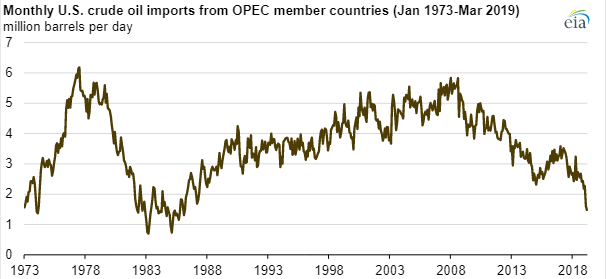
While the onshore boom has altered oil supply and demand both domestically and globally, pockets of the U.S. remain far too reliant on foreign energy. California imported 57.5 percent of its crude oil from foreign sources in 2018, up from 48 percent in 2008 -- all while billions of barrels of oil lay right off its own coast. Massachusetts is importing foreign liquefied natural gas, including LNG from Russia, while discoveries off of Senegal hint that the geologically similar U.S. Atlantic coast could hold greater energy resources than anticipated.
Read the full op-ed here.
Randall Luthi is president of the National Ocean Industries Association (NOIA).
For Immediate Release: Thursday, May 2, 2019
Contact: Nicolette Nye, (202) 465-8463, nnye@nullnoia.org
NOIA Welcomes Final Well Control Rule
Washington, D.C. – National Ocean Industries Association President Randall Luthi issued the following statement on the final Well Control Rule announced today by the Department of the Interior:
“The oil and gas industry and Federal regulators share a common goal: safe, efficient and environmentally responsible development of energy resources in the Outer Continental Shelf. NOIA applauds the Bureau of Safety and Environmental Enforcement (BSEE) for acknowledging that the 2016 Well Control Rule (WCR), while well intentioned, was flawed with technical problems that actually detracted from the goal of safe operations. BSSE’s final revisions, which leave the original rule largely intact, further manage risks and better protect workers and the environment, making drilling safer.
“Crafted to focus on ways to improve safety and allow companies to meet requirements in a safe, verifiable and practical manner, the new rule will result in a stronger regulatory process. The narrowly focused revisions incorporate adaptive guidelines and innovative technology and will standardize the process for departures, or alternative compliance.
“The final rule establishes a logical and collaborative process targeting the shared goal of zero accidents and incidents. In the end, nothing is more important to the oil and gas industry or the regulator than the safety of our people and environmental protection of our waters and coasts.”
ABOUT NOIA
NOIA is the only national trade association representing all segments of the offshore industry with an interest in the exploration and production of both traditional and renewable energy resources on the nation’s outer continental shelf. NOIA’s mission is to secure reliable access and a fair regulatory and economic environment for the companies that develop the nation’s valuable offshore energy resources in an environmentally responsible manner. The NOIA membership comprises about 250 companies engaged in business activities ranging from producing to drilling, engineering to marine and air transport, offshore construction to equipment manufacture and supply, telecommunications to finance and insurance, and renewable energy.

For Immediate Release: Thursday, April 25, 2019
Contact: Nicolette Nye, (202) 465-8463, nnye@nullnoia.org
Contact: Justin Williams, (202) 465-8464, jwilliams@nullnoia.org
NOIA Statement on Interior’s Indefinite Delay of New Five Year Program
Washington, D.C. – National Ocean Industries Association (NOIA) President Randall Luthi today issued the following statement after Secretary of the Interior David Bernhardt said development of the new Five Year Program is delayed:
“The Secretary’s statement certainly raises one eyebrow, but a further review of the Five Year Program under development due to a recent lower court decision regarding Alaska offshore access was not unexpected. While there is no firm guess on what “indefinitely” means, it clearly indicates we won’t see a draft plan tomorrow, nor did we expect to. However, Interior should still evaluate the option of moving ahead with a proposed plan, with the caveat that the areas that are affected by the previous withdrawal could be excluded from an eventual sale. A hard stop negates months of environmental and economic analysis that could be used to move the plan forward. Again, this is not a final plan, it is a proposed plan.
“While litigation can take unexpected twists and turns, it is important to note that the offshore energy industry is finally starting to recover. U.S. offshore investments are even outpacing shale, but there is a very real chance that companies will decide to invest billions of dollars into other foreign offshore energy markets free from litigious activism.
“What cannot be delayed, however, is the importance of domestic production to meet the growing demand for affordable, reliable American energy. While Democratic presidential candidates are bowing to Keep It in the Ground activists, California is launching yet another an investigation into the state’s exorbitant gasoline prices (Californians paid close to $10 billion for premium-priced Saudi crude oil during 2018) and New England stayed warm this winter as residents relied on imports of Russian LNG. It is clear that the high-energy prices and policies of California and New England should serve as a real a warning to what happens when rational energy policies that promote domestic development are abandoned.
“NOIA will continue our advocacy work in educating regulators, legislators, the public and other stakeholders on the benefits of safe and reliable energy access. We are hopeful that there is a path forward in developing an offshore plan with Secretary that secures America’s energy future.”
ABOUT NOIA
NOIA is the only national trade association representing all segments of the offshore industry with an interest in the exploration and production of both traditional and renewable energy resources on the nation’s outer continental shelf. NOIA’s mission is to secure reliable access and a fair regulatory and economic environment for the companies that develop the nation’s valuable offshore energy resources in an environmentally responsible manner. The NOIA membership comprises about 250 companies engaged in business activities ranging from producing to drilling, engineering to marine and air transport, offshore construction to equipment manufacture and supply, telecommunications to finance and insurance, and renewable energy.